The commitment lives on to spread ideas. But the format has changed. Want to catch up on the conversation?
Friday, February 12, 2021

Monday, November 11, 2019
"Choosing" how to live in a motorist's world
The hidden choices most of us make quietly in our subconscious: "my car" is the natural choice for getting where I'm going comfortably and on-time. Hidden behind said choice was a context of an existing landscape and urban system that was shaped by a history of profound choices. Choices so profound they totally transformed the landscape around us in the name of a prosperous dream in less than three generations.
Today, the dream is shaped by objectives people who started this experiment, a mix of suburbia and mass motorism, had never started with and never contemplated. Their ideals were dreams of a healthy, prosperous, safe existence. Those goals have been lost to long commutes by an unhealthy population, cost-burdened by housing + automotive costs, and our walks (or bike rides) across/along the street are about the most dangerous thing we regularly encounter. And things are not so great for motorists all the time either, as navigating an intersection is risky business for you (and your loved ones).
Hidden away in this dilemma are choices (thank you, democracy!). Choices to NOT intervene, to NOT embark on a counter offensive to course correct our trajectory of landscape transformation and urban system design is still a CHOICE. Those with power and wealth to succeed in the system are those with the most to risk in disrupting the system. The (often we) grown adults don't want to eat vegetables (or we think half-measures like a vitamin pill will suffice).
[a note about "power"... to some degree, we all have it... some ought to share it, some ought to realize it, we all ought to encourage one another to collaborate in exercising it]
Results of our passive non-choices for a counter-offensive:
- The CARnage is washed away.
- The victims are still blamed.
- The reckless are still unaccountable.
The system was built on rules that seem objective (They used math. Math!), but an underlying history of choices are found to have favored the elite motorist (because only the wealthy owned cars when much of the rules of the road were established).
THE LESSON: DESIGNING A SYSTEM TO BE UNIVERSALLY BALANCED NEEDS BALANCED PERSPECTIVES AT THE DECISION-MAKING TABLE.
Unfortunately, even as the motorist revolution became shared with a wider spectrum of incomes, the system didn't scale well and was not inclusive or universal in its benefits. With the imposed preferences of the motorist being applied to the broad landscape came the foundation for the subconscious decision (by all who were subjected to the whims of the motorist) to choose motorism. Why?
- to span farther distances (distances that only made sense for a growing segment of the population that traveled distances quickly),
- to be safer (wrapped in a metal box so that your own squishy body wasn't as endangered during your trips),
- to provide luxury and entertainment to help you overcome the boring blandness that now lined the streets and the fade away of urban design that once responded to people who could interact with it (interaction between real people and real things is demoted by the motorists shell, no longer do they have the nuanced experience of social chatter, the smell of fresh coffee/pastries, the display in the window, or the event flyer promoting local talent).
For those having new exposure to the cars-required historical narrative may feel skeptical. Good! But, let me be clear. Not all these changes are masterfully orchestrated by motorists who wish to promote mass motorism. This isn't a villainous plot. Much of what was lost was not intentionally wiped away (thankfully, not all). It was far more ordinary (yet complicated) in its evolution than a classic story archetype where a hero slays the monster. This is the confluence of all of us subverted by a system that we have to see for what it really is before we (hopefully an inclusive "we") can shape a contextual response.
Americans, many of us, live in a development pattern that is a market response to an influential technology, the ubiquitous personal/family automobile, that radically changed our interaction/relationship between one another and with our landscape. Mass motorism has diminished our nuanced understanding of the urban design elements that promote human-flourishing and many cherished aspects of civilization. It absolutely takes significant mental effort of translating what we see and our behavioral norms to digest the cause and effects of our collective decisions (in mass industry & governance) so that we can formulate an informed counter-offensive to revive the original goals of the American Dream.
It is possible, but will we decide, rule-by-rule, fund-by-fund to course correct our "cars-required" choices?
I hope so.
Saturday, August 17, 2019
Worthwhile Investments: Place Shaping Systems
 |
| Jan Gehl | Photo by Luiz Munhoz |
.jpg)
I credit Jan Gehl for the greatest impression on my appreciation for urban systems and spatial influences. I remember reading about architectural design critiques in college, and there was this incredibly insightful, paradigm-shifting wisdom imparted on me: The speed at which people experience place imposes a logic for the design of place or placelessness. Gehl coined the expression “60 Mile-Per-Hour Architecture” that conveys a powerful logical conclusion. Generic, bland, placeless design is the only worthwhile cost-cutting investment along a corridor built for speed. He realized there is no payoff for designing and building for intimate, social, and publicly inviting experiences when said experiences take time to enjoy. Passing through or by a place at high speeds negates the ability to really experience it. Fragility of these places are why they erode, unworthy of long-term investment, and incompatible with a social public realm.
Maybe the next freeway exit, only another minute away, is the optimal investment. Then the next.
The frail existence of “prized locations” along freeway exits makes this truth evident. Little effort is required to find tired shopping mall after tired shopping mall where a string of these buildings have reached 30 years old (or older and more tired)... these examples demonstrate the inevitability of building for placelessness. They decay, fail, and become a liability to the stability and perception of any city. These modern ruins can be reinvented, and some miracle-makers are innovating strategies to reinvest and rebuild the ruins, but they know the struggle extends beyond the immediate site design. Complications include high costs of retrofits or the poor quality of the original construction materials. No matter the miraculously reimagined site, there often remains the underlying contextual problem: speed.
If speed around or through the place remains pervasive, the potential for placemaking suffers. A worthwhile investment in place requires healthy land markets and return on long-term investments. The place has to be lovable, connected, safe, affordable (to all strata of income), and accessible by those who take enough interest to happily move slowly and linger in the space. Walkability offers more promise than the average motorist can fathom, but they can try thanks to the writing of Jeff Speck.
I don’t like to reduce people to purely consumers with discretionary incomes, but for the sake of simplicity, imagine everyone is simply that. Consumers who travel at high speeds will spread that income around thinner, farther from home and work, making every merchant or place more vulnerable to being traded in for that new place down a few more exits.
Why am I layering on this speed problem so thick? Because the truth is nuanced.
Conventional wisdom blames the Euclidean Zoning scheme for separating land uses (Euclid v. Ambler, 1926). I half-way agree, the use-based zoning scheme produced, and still produces, a logic for the mobility interventions that followed. With the distances between separated uses came the desire to span distances quicker, and speedy mobility became a logical necessity. At first, the streetcar suburbs were optimized for proximity and efficient modes of travel, but this didn’t scale in a desirable way for land speculators (not then, not now). Landholding investors need a system that continually opens up more space for investment so short-term development can begin its 30-year decay someplace away from the matured decay. By the 1960s, transportation engineering doctrine was at its peak with policy and funding to ensure highways were as American as apple pie (Federal Aid Highway Act, 1956). Of course, nearly every “advanced” Western Democracy had their own version and were throwing big money at a lot of “advanced” high-capacity, high-speed transportation infrastructure with convenient, free use for anyone… except for those whose neighborhood was demolished in its path or denied a mortgage because of the color of their skin.
The in-a-nutshell argument that could make me sound grumpy and unpleasant:
Awful land use policy provided the logic for awful transportation policy and with it came a reinforcing systemic cycle of awful inequitable impacts to human health, dignity, ecology, and economy. Meanwhile, taxpayer investments fund projects that promote unproductive development patterns while simultaneously cost-burdening the unborn and unrepresented. The system is stupidly unsustainable and tragically institutionalized making it painfully complex to course-correct while (distorted) market demand for highways and land speculation is still strong and rarely fully understood.
With this mess being observed for over 60 years, there are well-documented lessons from these development schemes with detrimental consequences. And there are great ideas to course-correct, but they won’t be mainstreamed without seriously provoking insights and breaking away from the entrenched status quo bias and myths within the American Dream.
Chuck Marohn of Strong Towns is a pioneer regarding the true costs behind his coined phrase “illusion of wealth.” The “illusion” is the misguided perception that new infrastructure is an asset. Sometimes it is. But, mostly, it is not. These expensive-to-upkeep physical assets become liabilities when placed within unproductive development patterns with low tax revenues, leading to long-term physical decay due to disinvestment from costs outpacing revenues. Low taxes are for the simple life. If low taxes are meant to upkeep loads of landscaping, wide streets, traffic lights, street lights, parks, curbs, sidewalks and emergency response it creates a broken social contract.
As far as I can tell, our “advanced” society is just barely climbing out of the dark ages of infrastructure policy (some regions/states are further along than others).
Transportation is the big fail. The USDOT a few years ago had Secretary Foxx celebrating the plan for #BeyondTraffic and now we regress with Secretary Chao constraining approved funding to qualifying transit projects. Those polarizing political fights are making their way down to local ballot initiatives as well (see Phoenix Proposition 105). Since speed ensures fragile development patterns, programs and funding for transportation infrastructure design is one of the major contributors to the systemic failures of contemporary city building.
See why traffic jams are up & removing fed help from transit (& other options) will make things worse-#beyondtraffic https://t.co/9rZDYpMexu— anthonyfoxx (@anthonyfoxx) June 7, 2017
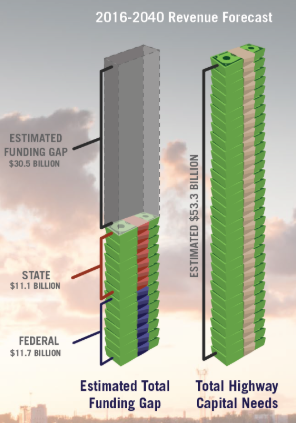 |
| ADOT Revenue Gap |
We have to ask ourselves, while being true to our values:
What system is worth the investment?
What yields a positive return on that investment?
What will not bankrupt the future?
What supports place-based economic development?
We cling to and preserve any places worth loving - most that predate the disastrous land use and transportation policies we’ve imposed on places for over 60 years. Our systems have long undermined the love for place, infill development, and healthy market informative feedbacks. Instead car-dependent policies offer the public obesity, injury, death, homelessness, depression, and cost-burdens (recommended: CNT’s Housing + Transportation Affordability Index).
The enemy of an aspirational place is the drag of despair. Burdens that drag our collective existence into time-burdened, cost-burdened, health-burdened, environmentally-strained condition have become evermore emotionally burdensome to me. I don’t want to promote this despair. I didn’t get into planning to promote “60 Mile-Per-Hour” placelessness that makes us sick, broke, and sad. I want to engage more and test the greatest ideas I have long admired.
A convergence of great ideas can promote a superior alternative to the current system. It’s a nexus that more professionals in the practice of city-building need to deeply understand to move the needle. There’s a nexus between efficient land use, efficient transportation, and cost-efficient infrastructure that promotes environments that are positive-sum for us and the planet and far less burdensome to multiple generation’s bank accounts and tax obligations. All these aspects of our system are oversized, meaning by finding efficiencies is correcting for the waste by right-sizing. It also means that with slower spread of people, we can enjoy our place more, making it a worthwhile investment with a complementary system.

Sunday, January 27, 2019
#NUFuture = #FiscalResilience
Both manmade and natural disasters leave our cities vulnerable to catastrophes ruining people’s health and wealth. CNU members passionately work toward building places people love, but the effort is undermined if such places are fragile and sickening landscapes placing the heaviest burdens to upon marginalized (trapped) populations. To restore our communities to vibrant urban places, we need an organizing principle that not only can measure the fragility of our physical city elements, but also provide a way to quantify the cost of the restoration we stand behind in the Charter of the New Urbanism. Most cities are held back by dysfunction and sprawl, and we deserve a method for demonstrating the costs of such dysfunction.
Graciously, the CNU initiatives to date have boldly organized physical solutions that have inspired many in their work. If there was ever a sense that the initiative omitted the whole truth of the cause it sought to rectify, members of the CNU were able to articulate such omissions and the initiative suffers. Therefore, any worthy #NUFuture initiative should not be compromised for political palatability.
Without soft, compromising language, let it be stated: The looming fiscal disasters of our cities should mobilize immediate and bold action. The vast majority of development across the country is further neglecting our shared future. The neglect spawns from an incomplete (or mismanaged) playbook by which development operates. I offer the following organization of worthy ideas boldly put forward by the CNU (to date) and offer ideas for the next effort:
- Land Use Development/Developers
- The Charter for the New Urbanism is organized at different scales of development. This structure is a strength of the organization’s principles, providing valuable nuance to the appropriate focus at each scale.
- Form-Based Codes continue to evolve and to replace use-based zoning codes with effective development standards that focus a city’s effort where it belongs: the Public Realm (at least in the most urban of the Transects). Also assisting in advancing people-scaled block patterns and complementing a complete portfolio of transportation options.
- Sprawl Repair seeks out opportunities for infill and untapped capacity in the landscape for prosperous opportunities for redevelopment, and incrementally evolving a dysfunctional place.
- Build a Better Burb is a close ally to Sprawl Repair (with infill), but challenges sprawl before its first poorly developed iteration. Financial liabilities of infrastructure considerations briefed.
- Incremental Developers Alliance mentors and grows the supply of urbanist developers with resources and training applicable to small scale, independent developers and builders.
- Transportation
- Street (re)design is a continuous work of refinement by CNU members, promoting access, ped sheds, protected bike lanes, invaluable urban design, detailed guidelines for walkable thoroughfares, and recently 101 steps for promising alternatives to insane levels of car dependence (#WalkableCityRules).
- No more #stroads. Prominent members are successfully repealing the methods and conventional wisdom that sought free-flowing car mobility and an oversupply of parking (😍 #ModernizingMitigation). Safe street advocates appear to be growing more organized and better informed.
- Public transit, with its slow adoption process across America, is proving to be incredibly valuable and better understood. Seattle is proving to be an invaluable case study. New Urbanists have long aspired to improve on the transit-oriented model for its ability to restore human scale to the streets.
- Fiscal Resilience (Can this be next?)
- A professional practice that is still taking shape, even as Strong Towns celebrates its 10th year. Strong Towns has elevated the concept that much of our (over)built infrastructure serves as a fiscal liability to our municipalities and public agencies.
- Promising firms offer illustrative and exploratory methods to inform the course correction, experimenting on implementation ideas in the spirit of the fiscal solvency crisis long embedded in the curbside chat.
- Is there specific actionable information here? Can the fundamentals be better documented and shared?
When it comes to building places that we love, fiscal resilience is still trying to inFORM (take in new data to form physically/operationally) our development metrics, transportation policies, capital investments, and comprehensive set of goals. It seems as though almost nobody denies the importance of the fiscal question, but few understand how to grasp and make actionable the fundamentals of its full potential. More can (and should be) done to advance the professional practice and marry the fiscal framework with other CNU initiatives.
The beauty of the fiscal framework is that it complements and grounds all other CNU initiatives. Land development, transportation, and infrastructure do not fund themselves (and theoretically set out to be resource sensitive). Every urbanist restoration project comes with significant costs. But (ah ha!), due to the robust functionalism of urban centers, these costs typically offer a return on investment (to both public and private sector alike; if not, make cost adjustments ASAP). It is this investment strategy and restored resilience that ought to advance and quantify the level of response necessary to deliver on CNU initiatives.
City leaders deserve to understand the fiscally quantified difference they can make over time. Their choice ought to be clearer: catastrophe or resilience. A city’s investments and returns on investments can be supported by a fiscally sound decision-making framework. The specifics of looming fiscal catastrophe should inform how aggressive a city operationalizes the restorative playbook.
***This information is compiled from my individual understanding of CNU initiatives and charter, which may be incomplete.***
Monday, January 7, 2019
Unsustainable Development Required
When it comes to failures, the planning field has broadly accepted that single-use zones applied monotonously across large parcels accounts for a great deal of consequential separation between where modern people “live, work, and play.” Planners understand these zoning practices, once intended to relieve the suffering conditions of the early industrial era, now serve as a barrier for people to experience the useful walk to a nearby destination. Remedies to zoning codes are broadly being applied to better zone for a mix of uses. However, there’s more to solving this riddle that is too often overlooked. Rather than letting these remedies actually foster better community development, there's still more fixes required. The following critique highlights another major example of how regulation applied uncritically has profound unintended consequences.
There's a formalized, efficient, and decisive test administered broadly across this country for almost every new development proposal and City-wide transportation plan to ensure that car-use is the most convenient, time-efficient, free-flowing form of transportation available in nearly every city and town across the county. This test is undervalued (or unknown) by many planners who have not challenged the merits of a fundamental traffic engineering metric. As planners standby, these tests oppress the potentiality of a sustainable relationship between people and their city. The test, applied with ultimate veto power, is defined by Traffic Engineering manuals as “Level of Service” (LOS) that is conventionally the bedrock of a “Transportation (or Traffic) Impact Analysis.” By requiring a passing grade on the LOS scale, a high degree of car dependence is required by design (often applied uncritically). To pass the test, developments often lose housing density or units or an optimal mix of uses for community vitality or relocate the project out on the fringe of town. These "mitigated impacts" (solving for flowing traffic, not livability) not only reduce potential profits for the developer, but lifestyles often associated with very popular destinations (developed prior to unhealthy amounts of car reliance).
Alternatives exist to the application of this LOS standard that is unwittingly hurled onto the people of a place, almost certainly without their consent or examining the costs. Largely, this decisive test is administered among “experts” who assume, without critical public discourse, the average car trips will be generated by a use, with some simplistic opportunities for “trip capture” (reduced traffic impacts to adjacent roads and intersections). The assumed value of free-flowing car use across a city is disassociated with commonly adopted goals of transit, active transportation, livability, equity, economic development, land use efficiency, cost of development, cost of maintenance, fiscal solvency, climate science, pollutant runoff, floodplains, household H+T index, community health, safe routes to school, aging in place, urban design, or many other worthy objectives that are drastically compromised (if not obliterated) with the ubiquitous requirement of a network of LOS A to C operating roadways devoid of a comforting, safe, and interesting public realm.
Until the errors of LOS are broadly understood by our profession, and the car culture assumptions challenged, the sad spread of sprawl will compromise the lives and the prosperous futures of more and more people trapped in a systemic failure of our making, all because we didn’t align our fundamental decisive tests of development with our comprehensive set of community goals.
For more on this critically important (and undervalued) topic, I direct you to writings by Dom Nozzi or Jeffrey Tumlin or the podcast "Level of Disservice" by Talking Headways.
x
Wednesday, May 23, 2018
Dear Smart (and Sexy) Traffic Engineer
Dear Smart (and Sexy) Traffic Engineer
Hey there, good lookin’. Do you come here often?
Did you hear the bad news? I’m supposed to kill you. No, no, I’m not dropping names and he definitely does not have the twitter handle @JeffSpeckAICP. But here’s a better idea. How about I buy you a drink in hopes that I get lucky (lucky enough to have safe and appealing streets where people enjoy life).
And here’s the thing, smartypants: I know you’re not to blame. Not really.
You’ve been given all the wrong parameters and the phony metrics and the appearance of doing “objective math” on how to move the cars. Everyone else is doing it. What are you supposed to do?I get it. I’m here for you, I see you here drowning in your sorrows as you try to find a way to deal with the inhumane practices you’ve been told to deploy on poor, unsuspecting cities across the world. There’s a way out, and I can help you (and nobody, and I mean nobody, has to die).
Do you know who can help fix this? Urban Planners.
Tell them they need to give you better parameters to work with. Tell them it all starts with aligning the metrics with broad goals of the city. Tell them they should facilitate REAL conversations with their city’s leadership.
Unless these Planners have, because they’ve probably tried, and they probably wish they were more effective, and they are likely dealing with people who don’t get it -- and maybe nobody from their team has heard of a stroad (the ugly, deadly hybrid of street and road).
So help them. Join forces. COL-LAB-OR-ATE! With your powers combined, you could do amazing plan-gineering things. Amazing things like (re)design streets that are loved by local residents and business owners alike. Streets with character and destinations for lively, not deadly, places people love.
Sure, you'll still have the naysayers. Those troublesome folks probably say, “My city isn’t Paris” and “here, people are different.” But, if you take a close look at those bipedal humanoids in the City of Not-Paris, I guarantee they have similar walking and biking abilities to those “Paris weirdos.” The difference, undoubtedly, is largely due to whether or not urban design has been applied along a city’s streets to make them appealing, comfortable, and connected. What are you doing for people who deserve appealing streets? Don’t tell me, you have meandering sidewalks that accommodate the drunk pedestrian as they stumble their way to nowhere. I’m not in the mood to be depressed; it makes me homicidal.
So, let me ask again: What are you doing now? You, the person who can kick ass and take names with the best of them. The smart (and sexy) Traffic Engineer that you are can be a force for good. A mighty force. Someone who is trained to solve problems with math and physics. Not that fake math crap that the traffic engineering standards would have you believe are a measure of anything worthwhile. You need design parameters that align with the city's goals.
A wise man once said: Pick your winners.
Winners are streets (or redesigned stroads) with the opportunity for Sprawl Repair. Find as many as you can. Recruit help. Build a sense of community while you build your physical community. Acknowledge that solving for free flowing, quick, convenient car travel works cross-purposes for the community life along these streets. Pick your winners, and design streets to beautiful places to hang out, be safe, be comfortable, and be a places that inspire people to love their city. There’s a broad community of doers here who can help.P.S. I’d hate for some driver to run you over and nobody be held accountable. ¯\_(ツ)_/¯
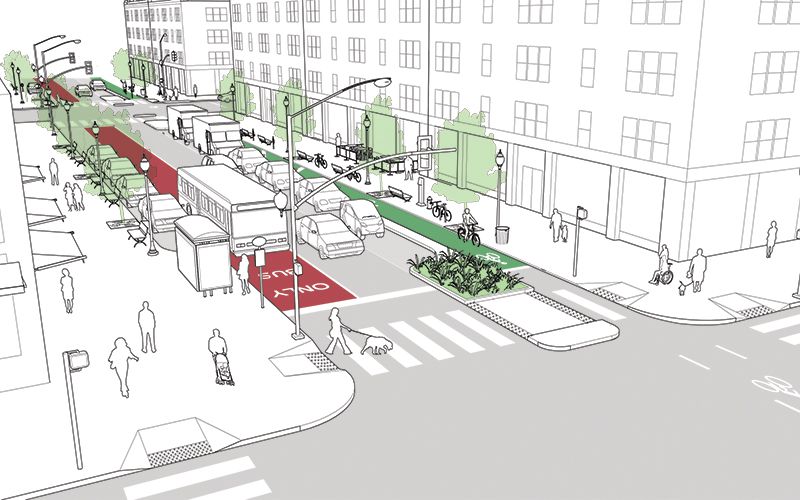
Image courtesy of NACTO
Tuesday, February 13, 2018
The Rich "Capture" Transit - a ponzi scheme in the making #Trump #Infrasture #Proposal
If you don't follow the Twitters, you may have missed the trending topic of #infrastructure as of yesterday when whitehouse.gov posted some guidelines and a legislative framework to make America's infrastructure great again. I went to the source, and at every turn of the Trump Administration's "Building a Stronger America" initiative, there is a common combination of proposals:
- Eliminate Regulations (lower expectations)
- Reduce Federal proportion of cost-share (states and cities, your allowance is slashed)
- Solicit Private Investors (cash-strapped state and local governments will have little choice)
- Promote Profiteering (exploit resources; remember, they're scrambling)
All types of infrastructure share in the aggressive shift of goals from serving the public interest to returns on investments. The topics range from water infrastructure, to access roads to public lands for resource extraction, to transportation (among others). Every type of infrastructure on the list, based on my review, all elements achieve the magic combination above.
Trump's proposal may not pass, but there are enough scary concepts that should be blocked before they become enacted by legislation. The bad ideas, taken one at a time, can be misleadingly tame in their quantity of terribility. Taken together, they're terribly terrible. The compounding terribility is akin to the compounding of the words: (1)Trump, (2) talking, (3) with women, (4) grabbing, and (5) grabbing by... nevermind. This demonstrates the wrong combination of things make the terrible, terrifying.
How does this relate to the much talked about #Infrastructure plan?
So let me explain how the wrong combination of proposals, bad city fiscal statuses, and desperation of cities can result in local governments being robbed by the wealthy investor class and savvy developer (legally, of course).
Potentially good ideas by themselves:
- Cities using value capture to sustain the revenues necessary to operate and maintain a first-class transit service
- Cities made to focus on generating a return on investments; not offer miserable transit that's federally subsidized
- Public-Private Partnerships (PPPs)
The Federal cost-share allocated to the cities in years prior have not always been used effectively. I point to the good work at Strong Towns to illustrate the arguments that liabilities of our over-built, under-utilized, poorly maintained roads, highways, interstates, bridges, and tunnels add up to a bunch of places that have a frightening fiscal future ahead of them as a lot of bills are coming due. Many at the same time.
What cities have been able to do effectively with a Federal project funds is to use it as leverage in bringing needed resources to the negotiations of PPPs. Transit stations could be (and have been) designed with space that offers leased space (maybe managed by and profitable to private firms operating within) that offered a return to the city. This is an example of value capture. Value capture studies record these returns at 6.5% to 7%, even in American cities where value capture is rare and not pursued aggressively (as it is in Hong Kong or Tokyo).
My expectation is, without those Federal project funds, cities will have far less leverage in the negotiations of PPPs. Instead, cash-strapped cities will compete over a limited supply of capable investors (compounded by the preserved lending power left over from quantitative easing policies). In the mismatched supply and demand, cities with desperate needs will be forced to take desperate measures with little guidance for best practices in how to navigate the new terrain of private funding and managing the new federally mandated value capture aspect to the project.
And with the private sector stepping in and financing the major share of these infrastructure projects, would they not be best suited to be first in line for the value captured from these brand new projects? As a mortgage holder, I know that my payments are meant to slowly benefit the principal owed. Would the financiers not treat cities similarly? Would the value capture rate not first benefit the investors? Will the private parties defer maintenance so that by the time the city starts to get a cut on the value capture that those returns will be eaten up on additional costs associated with older equipment and infrastructure? With a profit motive, is there not opportunity to see value capture models get aggressive?

Some of these ideas (i.e. value capture) work well on their own, but in conjunction with the rest of the conditions, I have serious concerns that the trillions of dollars worth of work that is needed across the country will be inequitable, insufficient, and parasitic results due to the ideological (not empirical) motivations to punish all forms of government, who supposedly does not contribute to wealth (according to the right-wing libertarian basic talking points), and continue the long played game of privatizing the profits and socializing the liabilities.
I hope I am wrong.
I also hope that if I am right that we move beyond the question of how much to spend, and talk about how it is spent.
I hope I am wrong.
I also hope that if I am right that we move beyond the question of how much to spend, and talk about how it is spent.
Thursday, October 6, 2016
Even the President is Paying Attention, Thanks Obama
The Whitehouse put out a report (Sept. 2016) that identifies a number of leverage points where local governments could take a good hard look at their regulations. Here's the list:
- Establishing by-right development
- Taxing vacant land or donate it to non-profit developers
- Streamlining or shortening permitting processes and timelines
- Eliminate off-street parking requirements
- Allowing accessory dwelling units
- Establishing density bonuses
- Enacting high-density and multifamily zoning
- Employing inclusionary zoning
- Establishing development tax or value capture incentives
- Using property tax abatements
The list is pretty good. Although, it should come with a caveat: The message is targeting urban areas with at least one transit corridor and a healthy land value to match. These healthy land values tend to inspire strategic investments by the developers to capture the value that already exists and has a momentum of growth and social allure (think the most sought after parts of Seattle, Portland, San Fran, NYC, Washington DC, or San Diego). The difference in suburbia there is still the need to evolve (at least in identified opportunity areas), and therefore the suburbs need to partner with developers who are trying to build equity in the long run, being strategic with the roll-out of the investment, carefully staging the phasing of a development to adapt with the evolving landscape.
For more, see the report for yourself here: https://www.whitehouse.gov/sites/whitehouse.gov/files/images/Housing_Development_Toolkit%20f.2.pdf
I'll break down the urban vs. suburban context and how these strategies need to take careful consideration of the context prior to implementing the toolkit. This will also serve as the start of the barriers to sustainable development, as there is a lot of overlap between that and the toolkit here. But, importantly, there are also important differences as I see them.
Wednesday, September 14, 2016
1980 - 2010, Low-Density Continues to Dominate the American Landscape
If you're like me...
you see that suburban America comes with a giant pile of problems we haven't even begun to really quantify, fully understand, or even remotely pay the cost of yet. And it is frustrating we really haven't shifted the growth model much in response to this growing call to action (well, at least those in the industry hear the call, I don't know about the general house hunter).Suburban problems...What am I talking about? Here's a short list:
- Air + water pollution from additional reliance on single-occupancy automotive transportation and the massive amounts of carbon fuel used to power the 1.2 billion cars (and growing) on the road
- Expensive infrastructure that hasn't paid for its own growth + maintenance in the long-run
- Suburbia is a tax burden to the urban economic engines of the country
- Uses more energy, water, resources that, unless technology can save us, is not consumed at rates of sustainable yield
- Suburban poverty is more difficult to manage and connect people to the social services they desperately need
- Health impacts adding inches to our waists and numerous other disease-associated factors
- Social isolation
- Loss of natural habitats and ecosystem services
- Loss of fertile farmland
A better alternative?
Urban environments are not without their own challenges of negative inflictions on our personal and ecological health, but they are measurably more sustainable from either a financial, environmental, and /or social perspective. Should they be forced upon everyone? No (and do yourself a favor and not listen to crazy talk that the Government is going to make you in accordance to the UN's Agenda 21).And then there are those who do low-density responsibly. There are those who have a low-impact lifestyle in the countryside who garden, live locally, and make the most of their land in an ecologically responsible way. Bravo to them.

Most of us need a reality check.
We at least owe it to the future generation to have a healthy, collaborative, sustainable lifestyle alternative to the human environment we seem to keep mass-producing for decades. The attached image demonstrates just how large of a tide we're up against. Even if you don't want to give up this suburban lifestyle (which is likely the only lifestyle you've ever really known), you owe it to your city to become a supporter of your downtown to grow into a densified, attractive, car-optional, pedestrian-oriented, bike-embracing, sufficient-minded, creative, compact, healthy, connected, energy- and water-efficient, tax-surplus oasis with a promising future.
Entry inspired by: Richard Florida's article in CityLab (9/14/16)...
Entry inspired by: Richard Florida's article in CityLab (9/14/16)...
The Difficulties of Density
Thursday, April 18, 2013
Designed to Fail the Small Scale
Suburbia has an image to uphold. The sales pitch offers things like ownership, pride, space, safety, quiet, clean, and friendly neighbors. With that space, people preserving their own space, and preserving a feeling of openness comes a great dependence on a machine to travel those distances at fast speeds and modern comforts required of a seat you'll spend many years of your life in. Unfortunately, that machine we've chosen (the car/truck/SUV) is big, inefficient, takes up that open space, pollutes, makes noise, creates a danger to kids walking to school (so notice the suburban sales pitch falls a little short of all the hype) and completely disrupts efficiencies in spatial economics so that retail or other business can work at the human scale. The car takes up space all the time and requires a driveway, garage, parking lots, road lanes, highway lanes, and maybe even off-road lanes. It's not impossible, but given the choices and preference shifts that come with this space-hungry environment, pedestrians and those competing for a chance at providing something at a smaller scale have immense challenges.
The latest victim of the suburban (sub)economy: Fresh & Easy Neighborhood Markets who are being abandoned by their English owners, Tesco. Tesco Express (of the U.K.) and Fresh & Easy (of the U.S.) are both small convenience-oriented grocers that offered ready-to-go lunches and prioritized freshness and healthy selections -- the difference being that Tesco Express's are profitable and Fresh & Easy's aren't... $1.8 billion (₤1 billion) loss reported for the U.S. chain. All the details in reports about the closing of Tesco's American experiment have focused on the same boring simplified line of "not understanding American culture." The listed mismanagements claim that Tesco didn't understand American preferences along the lines of flavors, selection, pricing, coupons, etc. I challenge this narrative as being far too limited (and bogus, mostly).

You might expect maybe you could find this pedestrian-friendliness in the most urban settings Fresh & Easy can be found in, so I offer in the top-right corner a store in San Francisco. While there are electric cables for transit above the road and street parking (unlike the other U.S. scenes), remaining are barriers to the pedestrian to reach the doors of the store. Notice the knee wall at the outer edge of the parking lot in front of the store. This knee wall makes sense, because headlights should be shielded from the road when these cars are only parking. HOWEVER, it's symbolic of how the prioritizing of the car once again disrupts the experience of the pedestrian in a series of ways.
This is something that is SLOWLY changing in the U.S.
Yet, for the most part, buildings being built across the U.S. are required to be "setback" from property lines in American cities. Typically, the only time municipalities will allow a new building to be built to the property line that shares the public space is where a special zoning code is applied called Form-Based Codes. I warn you however, in a majority of our (sub)urban space, these codes are thought FAR too progressive by local council members. Many residents remain low-intensity advocates making a fuss over the need for generous setbacks, two-story building height limits and require ample parking lots.
The latest victim of the suburban (sub)economy: Fresh & Easy Neighborhood Markets who are being abandoned by their English owners, Tesco. Tesco Express (of the U.K.) and Fresh & Easy (of the U.S.) are both small convenience-oriented grocers that offered ready-to-go lunches and prioritized freshness and healthy selections -- the difference being that Tesco Express's are profitable and Fresh & Easy's aren't... $1.8 billion (₤1 billion) loss reported for the U.S. chain. All the details in reports about the closing of Tesco's American experiment have focused on the same boring simplified line of "not understanding American culture." The listed mismanagements claim that Tesco didn't understand American preferences along the lines of flavors, selection, pricing, coupons, etc. I challenge this narrative as being far too limited (and bogus, mostly).
Here's the rest of the story:
In one simple graphic I've collected views of Tesco's stores in the U.K. (left column) versus views of the Fresh & Easy stores of California, Nevada, and Arizona (right column).
These images were all captured by using Google Map's street view (one of planner's favorite tools for quickly exploring urban geography - Google Earth helps too with topography). While I did my best to select from a variety of cities throughout England, the scenes all looked very similar (except for the maybe last one from Rugby). In the collection of American views, I always tried to select stores located near the urban core of respected locations, if available (from top to bottom: San Francisco, CA; Los Angeles, CA; Sacramento, CA; Sunrise Manor, NV; Phoenix, AZ).
Here are some themes that contrast the U.S. from our neighbors across the pond:
The following are the physical (built environment) conditions that shops like Fresh & Easy and Tesco Express often depend upon just to have the potential to thrive.
1. Mixed Use
In EVERY case from the U.K. the store is part of a building that serves as more than a store. With offices or housing above the store, every store is sure to have potential customers mere feet (or, since this is the U.K., meters) away. In EVERY pictured F&E in America, this is NOT the case. Instead, they have nice elegant architecture, but are part of retail-only shopping centers or stand-alone buildings. Engineering our built environment comes with a responsibility of monitoring how it PERFORMS (not just its aesthetics).
2. Storefront to the public (and doors at the sidewalk)
While there is very little architectural interest in these U.K. storefronts (simple awnings, glass sheet windows) they FUNCTION for the benefit of attracting customers. There are whole blocks of buildings and destinations that align to this same standard. The multiple destinations, complemented with street parking, shade trees, narrow roads and wide sidewalks prioritize the needs of the pedestrian. People have a perfectly good rationale for choosing to ditch a car and take a trip by foot instead. And even if U.K. customers do drive, the destination will likely be closer since they will pass a series of properties WITHOUT wasted space along the drive.
This is something that is SLOWLY changing in the U.S.
Yet, for the most part, buildings being built across the U.S. are required to be "setback" from property lines in American cities. Typically, the only time municipalities will allow a new building to be built to the property line that shares the public space is where a special zoning code is applied called Form-Based Codes. I warn you however, in a majority of our (sub)urban space, these codes are thought FAR too progressive by local council members. Many residents remain low-intensity advocates making a fuss over the need for generous setbacks, two-story building height limits and require ample parking lots.
3. Complete Streets, not Urban Highways
When a street exceeds 5 lanes (2 in either direction with a shared turn lane), it starts to take on a feel that it is engineered to move people through, rather than explore, shop, or be a part of your life. The destinations go unappreciated as cars zoom by at 45 MPH. That is not a street that a range of activity can feel comfortable on. The faster people move through it, the less FUNCTIONAL it becomes for achieving what cities were meant to achieve in the first place (hint: it's not to serve as a highway).
It's also more than about the number of lanes and the speed of traffic. Those only deter a variety of users. The next step is to move beyond that and find assets for cyclists and pedestrians, such as convenient, safe crosswalks, street trees, benches, flowers, shade, wide sidewalks, variety of destinations within the same mile walk, protected bike lanes, bike racks, street parking, and proper lighting for the nightlife.
And these are just the top three physical planning attributes that go unappreciated by the mainstream analysis in the discussion of why Fresh & Easy failed. Until we recognize the ways our urban design depresses the spatial elements of our economy, we'll never be asking the right questions or pursuing the right solutions. If you agree, you have a responsibility to voice this concern to your local council member. Tell them briefly that you support (1) mixed use development, (2) form-based codes, and (3) complete streets.
Still not convinced? Let's explore how the lack of these elements within our productive community cores can affect behavior.
1a. Lack of Mixed Use
This has to do with pooling enough discretionary income and variety of culture to develop a market of consumers, producers, and influencers. I'm talking about more than the simple expendable commodities that make it to the landfill like your phone in a year. With urban cores that support a creative class comes music, performance, culinary experiences, groceries, social and political movements, books, drinks, dance floors, sports, etc. These happen best when we're not all competing to buy more space to spread ourselves out and remain in our walled off back yards. This requires collaborative space and social mingling in common areas of our lives (and gridlock on your expressway doesn't count -- we're not collaborating then, we're competing to get away from each other).
What does this have to do with Fresh & Easy (or any small business whose business model requires frequent small transactions with customers)? When we make a trip in our car (which is something few of us look forward to doing), we have a tendency to want to "stock up" and we also need a place to store such stocked items (in transport and in our home). This behavioral motive helps people determine the need for an SUV or large trunk and then a super-size pantry. These concepts counter the business model of most small businesses that cannot afford a store with a mega footprint to offer customers everything in the world at bulk rates. And, by the way, not EVERYONE has to live in these mixed use buildings, but the mixed use environment needs to be offered in pockets of our city centers at the least to achieve urban economies that FUNCTION.
2a. Lack of Proper Urban Form (Form-Based Codes)
Space is formed with interior rooms and exterior rooms. Space between a building and street trees, building and curb, awning and sidewalk... these are all exterior spaces that create outdoor rooms. We've done alright with interior rooms in America. We have far less of a portfolio with exterior spaces that rival the plazas of Italy, for example.
Here's an analogy: Without a proper meeting space, a company lacks a place for round table discussions and decisions. Without proper spaces in the public, quasi-public, quasi-private, and private realms, there are many functions of our social and economic lives that lack the appropriate space to function well.
Here's an analogy: Without a proper meeting space, a company lacks a place for round table discussions and decisions. Without proper spaces in the public, quasi-public, quasi-private, and private realms, there are many functions of our social and economic lives that lack the appropriate space to function well.
England has inherited an urban form that functions in a way that serves the human scale. It wasn't built with codes and compliance measures that offered priority to people's personal automobile. The western states Fresh & Easy ventured into didn't have that pedestrian history. Urban design has transferred much of its residents' proximity concerns to minimum parking space requirements, large landscape tracts between the parking and the street, and the aggregation of a lot of personal space (big suburban lots) that stands in the way between resident and destination. With the average stride length of 2.6 feet and only walking 2.8 - 3.5 MPH, distance from door to door means a lot more in effort and time to the pedestrian than the motorist (and even motorists are pedestrians when they get out of their car!).
3a. Lack of Complete Streets
As a species, we've only been getting around by car for a handful of decades. For thousands of years, cities functioned without large, ultrafast motorized traffic. Since the invention and the general acquisition of the automobile, cities have spread across more land, cutting more trees, requiring more fossil fuels, more pavement, more stone, more lumber, more water, and it has added up quickly to produce a collective conundrum.
Our individual preferences (or compromised preferences based on a balance of options and needs) have not prioritized/optimized our spatial outcomes as a society. This means that in order to manage space, we've offered more lanes of traffic on expressways, which have only encouraged people to move farther from their jobs and acquire more personal space in newer suburbs. The whole transportation system requires incentives to encourage different behavior from commuters, shoppers, students, wanderers, tourists, ect. Complete Streets offer an alternative that returns balance to the priorities in our multimodal era of travel. Without countering the automotive dominance (and dependence), we'll constantly be undermining the Main Street developments that have always served as the home for small, local business(wo)men who could depend on a consistent and well developed market of local residents. It is home to the hot dog stand, the specialized hardware store, and the small convenience store all with CEOs who lived in your neighborhood and shared in the successes or failures of your community.
Implementing Complete Streets challenges the Big Box stores and the way they function/retain market share. Big Box retailers have successfully altered the buying habits of the suburban American to buying in bulk with over-sized carts, transferred to over-sized trunks, to over-sized pantries, with overly-processed foods and even leading to oversized meals and caloric intakes (to some extent). Complete Streets offers the alternative of buying in smaller quantities, as you need, and you carry home what you can... allowing you to buy fresh ingredients. This will require time used to watch TV, time to perhaps interact with your fellow community members more, and steps that burn those extra calories your Big Box gym has convinced you only they can solve.
Saturday, March 9, 2013
Planning "solutions" to Bitter Pill by Steven Brill
If you haven't read Steven Brill's Time cover story that made all sorts of news these past weeks, you should check it out for yourself. If you don't have 2-3 hours to devote to reading all 24,000+ words that will make your blood boil, let's see if I can quickly summarize it for you:
Brill brilliantly asks the question, not who should pay for medical bills, but instead, why are health care costs so high? He takes a mix of experiences had by people who all have encountered bills that break the bank. Two starkly different scenarios are a guy with cancer and another person who is rushed to the ER after falling. The common thread is the unsubstantiated price of service trapping the unwilling buyer now stuck with a bill that offers little transparency or accountability. This is a pricing luxury not shared by many sectors of the economy where most industries have sacrificed and are doing more with less. It's as if the medical industry exists in another economy. Hospitals across the country, whether not-for-profit or for-profit, are recording huge surpluses of cash off the backs of small insurance providers/customers and those without insurance -- only Medicare, the largest buyer of health care, seems to pay prices based off of what the care actually costs to provide. Brill mentions CEOs of not-for-profit hospitals who make over a million dollars a year. This compensation, Brill mentions, can easily be rationalized for running complex hospitals that save untold numbers of lives. But he scoffs at the fact that any hospital can charge $77 for a gauze pad (one of many exorbitant prices for simple medical supplies) or thousands of dollars for one treatment of a cancer super drug that sells in other countries (with the use of price controls on these monopolized/patented drugs) for less than half the cost paid by his example of the cancer patient. Even in countries with price controls on these monopolized life-saving drugs, companies are still happy to operate profitably. In other articles I've read about drug price controls, it's understood that the patent protecting new drugs is a monopoly power that ought to be checked by regulators. If these prices aren't checked, who else is left to keep the prices from reaching the point where greed costs lives?
In a nut shell, Brill highlights the unique power that Medicare has with negotiating realistic prices and thinks highly of its powers to save us in the real economy from being abused by the monopolistic powers found in all parts of the health care industry (ambulance, hospitals, drug companies, machinery, ect.). He argues that more could be done if Medicare wasn't "handcuffed" by Congress from negotiating on tests and other things. And thanks to the test loophole, tests maybe ran more frequently than necessary (but why leave expensive machinery sitting around unused when it could be utilized and pay for itself?).Other fine responses to Brill's work (but none from a planning perspective): here here here here and here
After reading Bitter Pill, and reading responses by various authors, and hearing Brill's interviews - I was convinced that the solution to affordable health care is going to be a multifaceted one. So the question for planners is, what can planning/zoning/urban design contribute? What can land use do to help relieve this monopoly power that regional hospitals have? Here I raise more questions than answers (but I try to interpret what some planning concepts will mean for our health care costs).
Part of the problem, as Brill points out, is that health care consumers are coerced customers that are buying before they know the price by simply taking their doctors advice. Many times, in an emergency situation, the hurt are at the mercy of responsive care and are then bound to pay the bills at the end. The lack of transparency and choice makes for a natural monopoly.
Here's an untested idea: what if planning policy encouraged regional hospitals to be less concentrated and more geographically dispersed? This would allow the physical breaking up the monopolies (competitors who wouldn't have to share the same space) to be more practical and/or give greater accessibility to health care facilities to everyone (from a proximity perspective). There may be drawbacks to this concept, such as a loss of efficiency with breaking up the regional hospital or the monopoly power - perhaps price controls are a better option and leave monopolies alone (maybe).
What solutions are there in EMS routing and making travel more responsive, safer, and faster? I know they use traffic signal overrides currently, but maybe there's more that can be done.
Are there impacts from our other land uses? Is suburban sprawl (or density) increasing the cost per capita for health care? Would more mixed use offer any benefit, cause complications, or have no effect? What are the effects of road diets?
Perhaps active transport and space for active recreation need to be prioritized according to health impact assessments. I know there is a lot of recent research in this area, what are the payoffs? What specific health care services will likely increase/decrease if active communities become standard?
What can local produce and urban gardening do for people's nutritional health? How might that influence the demand for certain health care services?
How many ER cases are the result of car accidents? What advancements in transportation will effect the costs to people from ER bills? It is suspected that computer driven cars will be safer. How much money will such car technology save us in lives and in ER bills?
Tuesday, February 19, 2013
Untangling the Dilemma: Ethics, Housing costs, Economics
Most planners strive to be AICP certified. It's a professional certification that offers more opportunities for professional work, promotions, clout, and an expectation to uphold a clear code of ethics published by the American Planning Association. But do those with AICP credentials actually adhere to the code of ethics? Do certified planners spend time thinking about how these less tangible standards become implemented? Do they scratch deeper than the surface to uproot any lingering injustices left over from the civil rights movement? And, if these planners see it, do they have the means to address it? Are such planners empowered by their bosses?, their clients?, and do local Commissioners/Council members tolerate shaking up the status quo?
I'm not sure if local officials from growing communities have the political courage to face issues of economic justice when luxurious development requires special attention (if not coaxing) and acquiring such development promises to raise the stature of the community. Housing diversity doesn't mesh well (whether political or marketable) with housing for the wealthy. The wealthy seem to require private airports armed with gates and offer exclusive perks like upscale clubhouses with spas and tennis courts and a choice of tee times. This exclusive space (with costly upkeep) is generally thought to be more exciting than affordable housing or cost-effect housing for working class families.
Is this a matter that was never reconciled in the civil rights movement? Is this practice of marketing neighborhoods to a certain demographic a remnant of a time where exclusive neighborhoods were plenty recognized by race? Is perpetuating the existence of exclusive neighborhoods (now divided by salary) really any different? Have people earned the right to live among only among those who share similar socioeconomic backgrounds?
It was also once perceived that housing for black and white families didn't mesh well with one another. I might suggest that the poor (working poor, ill poor, underemployed poor, uneducated poor, undocumented poor, etc.) of today deal with a similar stigma that were once reserved for black households of the 1950s and 1960s (or any time before Fair Housing regulations of the Civil Rights Act of 1968). Even after passage of the Act, there were holdouts on the practice of redlining where black home buyers were denied access to (or steered away from) certain neighborhoods by one means or another. Housing discrimination only protects people based on race, color, religion, or national origin (and I believe expanded to include disability/handicap and familial status) at the federal level. Other protections have been applied in certain states to protect LGBT or age discrimination. I also think that these cases of discrimination are seen for what they are: bigotry and a form of injustice. Regretfully, issues of segregation by class remain as an accepted stratification of our economic reality that upholds the idea that we all earn our place in society. It is commonly justified in everyday rhetoric that money earned is a sign of dignity, accomplishment, and stature earning a person the right to isolation from the downsides of income stratification.
What do you think? Do we need to take a careful look at our beliefs about housing "markets" along lines of income stratification? Have we accepted upper class enclaves that segregate people along new lines of discrimination by doing so?
Take these ideas and read what AICP has to say about Housing Policy and planner's "responsibility to support the needs of underrepresented and disadvantaged people." Does the diversity within neighborhoods offer social cohesion even between people at different ends of the pay scale? Is the way we zone and implement design regulation have an impact on this outcome? I carefully question common practice and its wisdom.
--- Addition 3/9/13 ---
I would also thank Marc Brenman for his contribution of bringing up another source that provides direction of Housing as a right under the UN's UNIVERSAL DECLARATION OF HUMAN RIGHTS.
I'm not sure if local officials from growing communities have the political courage to face issues of economic justice when luxurious development requires special attention (if not coaxing) and acquiring such development promises to raise the stature of the community. Housing diversity doesn't mesh well (whether political or marketable) with housing for the wealthy. The wealthy seem to require private airports armed with gates and offer exclusive perks like upscale clubhouses with spas and tennis courts and a choice of tee times. This exclusive space (with costly upkeep) is generally thought to be more exciting than affordable housing or cost-effect housing for working class families.
Is this a matter that was never reconciled in the civil rights movement? Is this practice of marketing neighborhoods to a certain demographic a remnant of a time where exclusive neighborhoods were plenty recognized by race? Is perpetuating the existence of exclusive neighborhoods (now divided by salary) really any different? Have people earned the right to live among only among those who share similar socioeconomic backgrounds?
It was also once perceived that housing for black and white families didn't mesh well with one another. I might suggest that the poor (working poor, ill poor, underemployed poor, uneducated poor, undocumented poor, etc.) of today deal with a similar stigma that were once reserved for black households of the 1950s and 1960s (or any time before Fair Housing regulations of the Civil Rights Act of 1968). Even after passage of the Act, there were holdouts on the practice of redlining where black home buyers were denied access to (or steered away from) certain neighborhoods by one means or another. Housing discrimination only protects people based on race, color, religion, or national origin (and I believe expanded to include disability/handicap and familial status) at the federal level. Other protections have been applied in certain states to protect LGBT or age discrimination. I also think that these cases of discrimination are seen for what they are: bigotry and a form of injustice. Regretfully, issues of segregation by class remain as an accepted stratification of our economic reality that upholds the idea that we all earn our place in society. It is commonly justified in everyday rhetoric that money earned is a sign of dignity, accomplishment, and stature earning a person the right to isolation from the downsides of income stratification.
What do you think? Do we need to take a careful look at our beliefs about housing "markets" along lines of income stratification? Have we accepted upper class enclaves that segregate people along new lines of discrimination by doing so?
Take these ideas and read what AICP has to say about Housing Policy and planner's "responsibility to support the needs of underrepresented and disadvantaged people." Does the diversity within neighborhoods offer social cohesion even between people at different ends of the pay scale? Is the way we zone and implement design regulation have an impact on this outcome? I carefully question common practice and its wisdom.
--- Addition 3/9/13 ---
I would also thank Marc Brenman for his contribution of bringing up another source that provides direction of Housing as a right under the UN's UNIVERSAL DECLARATION OF HUMAN RIGHTS.
Wednesday, October 5, 2011
Labor shortage, Farming, and Immigration policy
The media today is focused on how immigration reform will impact our economic possibilities and realities. Today's article from Kirk Johnson in the NYTimes highlights an American workforce not willing to take hard farm jobs. Through my best urban sociologist lens, I view people wanting more than to simply "fill jobs" -- but that is not the way the story is presented. This article was also referenced in a spirited debate this morning on the Diane Rehm Show.
The dialogue revolves around the context of new (legally challenged and court confirmed) immigration policy and how it coerces undocumented workers back to their home country - potentially leaving crops unharvested.
I shake my head at this kind of analysis, because it overlooks the complexity of the social dimension when observing people's job selection process as well as the historical trend of people migrating to cities. The farming industry has been altered immensely through a technological overhaul that dates back to the industrial revolution. However, new technology is usually received with mixed reviews because of how it typically leaves low-skilled workers without jobs, replaced by machinery. This unsettling news is no comfort to the low-skilled workers in this country that are suffering most from unemployment. Yet, despite their relatively low skill (and subsequently low wage), they have quality of life expectations that the rural farm setting does not offer.
Evidence to this fact can be seen in the affinity that low wage workers have for city centers. It is the city that offers affordable transportation, social opportunities and a quality of life that is made interesting by the unique opportunities to urban life. Ever since the industrial revolution and the invention of machinery that has replaced farm jobs, people have been migrating to the city nonstop. If it were for only employment opportunity, farm labor shortage should have them migrating back -- but these people are choosing to stay in the city. This is evidence for the quality of life that cities offer over their rural neighbors. Despite one out of 11 people are unemployed, these folks still choose the city to the rural farm life.
 So if a labor shortage in rural farm country cannot lure people out of the city, perhaps it is time to bring the farm to the city. The vertical farm might be a viable option. This potential solution looks to face the problem of feeding a population on an exponential growth projection and the fact that there is no stopping people choosing their home in a city rather than a rural farm.
But this doesn't offer politicians an easy way to skirt the pressing issues of immigration policy. For too long, it seems that we've been addressing immigration with the following questions:
- "What will it do for the benefit of our economic well being?"
- "What stress will it put our social services under?"
- "Why should our tax dollars pay to educate these children?"
I think these are the wrong questions and they only look at the problem under a very short timeline and avoid moral humanitarian perspectives. My questions are more about what if we don't open up opportunities to our neighboring nation? What will make the pressure of managing "illegals" subside? Taller fences? More armed guards? Security will not add value to our economy. Investing in human potential, immigrant or domestic, may be more productive (although I would like to see empirical evidence on the matter).
Tuesday, September 27, 2011
Refreshing Opportunities
Despite the economic downturn, it is exciting to see when creativity pushes through and we find innovative solutions like the ones offered in the blog post by Melissa Hege. See the link below...
http://www.planetizen.com/node/51365
http://www.planetizen.com/node/51365
Friday, June 3, 2011
Interconnectedness

No one person, one profession, one chemist, one biologist can live in a modern city, while isolated, and consider themselves truly sustainable. Communities rely upon common goals, common space, common infrastructure, etc. All these commonalities mean that we share in one another’s fate. Progress or regress is shared in some spillover. Our environments are places where we exchange ideas, money, emotion, illness, stress, and so much more.
Our lives are interconnected. To some, that is met with alarm and distrust. Such reaction is usually followed by withdrawing as much as possible and they worry about getting out, becoming self-reliant, and even “off the grid.” But even when extreme measures have been taken, a person’s water, air, and food can become threatened from far away distances.
Let’s not fall into the trap of every-man-for-himself. I believe that the only way to confront the challenges of sustainability are to embrace our interconnectedness and work together with our own unique perspective to weave a complete vision of what our world could be. Biologists, urbanists, psychologists, surgeons, survivalists, engineers, mothers... EVERYONE has a life to live with their own needs to meet. With cooperation and embracing our shared existence, we can come together in ways that promote the Social Capital I mention in my Sustainability post.

What does something with that much synergy and cooperation look like? I am not sure myself. What I do know is that we cannot assume that we have all the answers within our own fields of knowledge. There is a complexity to this world that no one person can put together alone. The good news is that today’s technology has us more connected than ever. A simple Google search eliminates many mysteries. But even Google has its limitations. We need a mix of expert opinions with contextual applications to help resolve the errors of our society. Recognize failure when you see it. Don’t be afraid to not have the answer. Do find the strength to start (or engage with) a coalition to change it.
Build a sense of community right where you live by getting involved in community development meetings held by your local city government! Google the name of your city and you will find that there are teams of people who are employed by your tax dollars that can work to make this happen --- but they need your involvement.
Subscribe to:
Posts (Atom)